On this page
CCAR-F practice questions and answers: the 20 in the free PDF
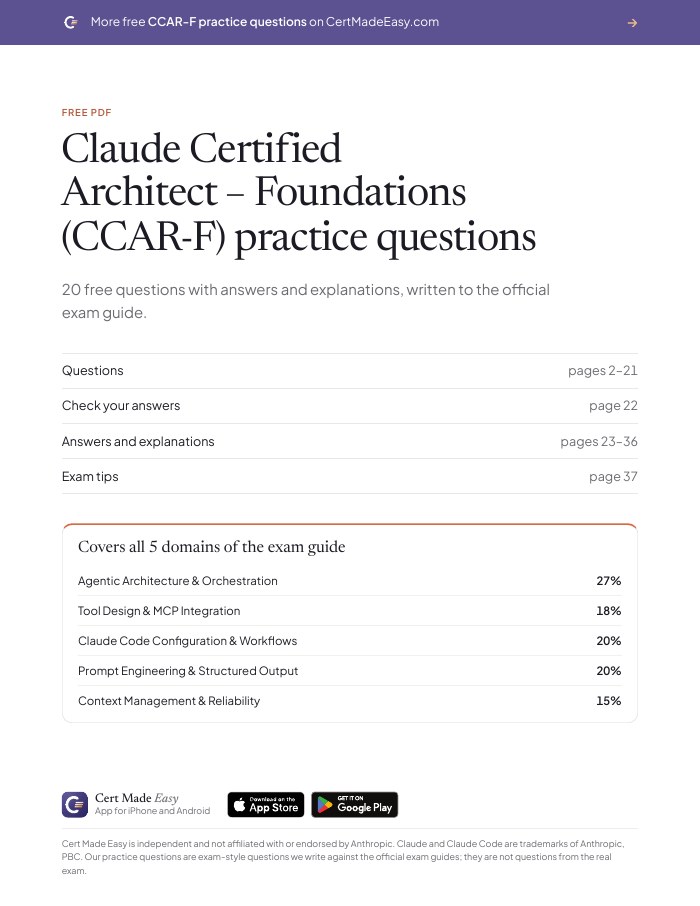
We wrote these 20 against the official CCAR-F exam guide; none is from the exam. They follow its domain weights as closely as 20 questions allow. Four ask you to pick two answers; on the exam, multiple-response questions say how many to pick. Try each before opening the answer. The PDF explains why every wrong option is wrong, plus an exam tip per question.
In normal weeks 9% of get_customer searches by email return an empty customers list, nearly all because the customer used a different address. During two CRM outages last month, each lasting about an hour, the MCP server caught every query timeout and also returned an empty list. The agent told 640 customers it found no account and asked them to create a new one.
What change would MOST effectively fix this?
- A. Retry the CRM query inside get_customer up to three times on a timeout, and return an empty customers list if every attempt fails.
- B. Return an isError result whenever get_customer finds no account, with a message telling the agent to ask the customer for another email.
- C. Have the agent call escalate_to_human whenever get_customer returns an empty customers list, so a person can check the account by hand.
- D. Return CRM timeouts as isError results marked transient and retryable, and keep returning an empty customers list when a search finds no match.
Show the answer
Refunds above $300 need a supervisor. A PostToolUse hook on process_refund reads the refunded amount and, above $300, adds context telling Claude to call escalate_to_human. An audit found 41 refunds above $300 last month, each issued and then escalated. Each refund emails the customer at once and incurs a processor fee, and human agents use the same refund backend for larger approved refunds.
What change would MOST effectively fix this?
- A. Have the PostToolUse hook call the payment system's reversal endpoint for any refund over $300, then tell Claude to escalate the case.
- B. Move the check into a PreToolUse hook on process_refund that denies calls over $300, with a reason telling Claude to escalate the case.
- C. Configure the refund backend to reject any request over $300, returning an error result that Claude can act on by escalating the case.
- D. State the $300 supervisor limit in the system prompt, with examples of contacts in which the agent escalates the case instead of refunding.
Show the answer
Logs show two problems. The synthesis subagent receives eight search subagents' findings pasted together in arrival order, and reports include the first and last subagents' findings in 94% of runs but the middle four subagents' findings in 51%. Separately, long sessions outgrew the context window, so the coordinator's history is now summarized every few turns; after a summary, 22% of delegations drop the user's date cutoff or required currency.
Which two changes should you make? (Select two.)
- A. Open the synthesis input with a short summary of each subagent's key findings, then give each subagent's full results under its own section header.
- B. Send the coordinator's full conversation history on each request instead of summaries, so the user's date cutoff and currency are kept word for word.
- C. Keep the user's stated constraints, such as date cutoffs and currency, in a block added to each coordinator request outside the summarized history.
- D. Have each search subagent return the full text of the pages it read, so the synthesis subagent can check each finding against the original wording.
- E. Have the coordinator summarize its history less often, every ten turns instead of every few, so the user's refinements stay verbatim for longer.
Show the answer
The team's review criteria, covering what counts as blocking and which patterns to leave alone, sit in the tech lead's ~/.claude/CLAUDE.md. The lead's local reviews apply them. The claude -p reviews on the CI runner do not, and neither do teammates' local sessions. The criteria change every few weeks, and the team wants each change reviewed in a pull request like code.
Which change would MOST reliably fix this?
- A. Keep the criteria in the lead's user-level file and add an @import of that ~/.claude path to the project's CLAUDE.md in the repository.
- B. Move the criteria into a CLAUDE.local.md file at the repository root so Claude Code loads them alongside the project's other instructions.
- C. Move the criteria into the project's CLAUDE.md at the repository root and commit it, so the runner's checkout and each clone load one file.
- D. Store the criteria in a file in the repository and pass it to the CI job's claude -p command with --append-system-prompt-file on each run.
Show the answer
For each bug report the team runs four stages: reproduce, locate, fix, and add a regression test. Locating ranges from one Grep to a trace across several services. A prototype with a fixed sequence of searches failed on most multi-service bugs. A second prototype, one free-form agent given the whole job, located bugs well but skipped the regression test in 20% of runs.
How should the workflow be structured?
- A. Keep the four stages as a fixed sequence in code, and run the locate stage as an agent loop that chooses its own searches.
- B. Keep the free-form agent and add a CLAUDE.md rule that each fix must include a regression test before the agent reports the bug as done.
- C. Keep the fixed search sequence and add more search patterns for traces across services, so the locate stage handles the harder bugs as well.
- D. Run the free-form agent twice for each bug and keep whichever run's output includes a regression test, discarding the other run's changes.
Show the answer
Purchase orders arrive from about 400 suppliers, many sending one order a year. The prompt holds three worked examples, all from one large supplier, each showing payment terms of Net 30 and a single address. payment_terms is nullable, and the prompt says to return null when terms are absent. Yet 14% of orders that state no terms come back as Net 30, and orders with separate billing and shipping addresses repeat the billing address in both fields. Every output passes validation.
What change would MOST effectively fix this?
- A. Validate each extraction in code, and retry any failing record with its specific validation errors appended to a follow-up request.
- B. Replace the examples with three or four orders from different suppliers, including one that states no terms and one that ships to a second address.
- C. Build a library holding one example order per supplier, and insert the matching supplier's example into each request at extraction time.
- D. Restate the null rule for payment_terms in capitals at the end of the prompt, after the document, so the model reads it last.
Show the answer
Logs show two problems. A nightly flaky-test triage step that a teammate added runs claude "$PROMPT" and hangs until the 60-minute CI timeout; its log ends at Claude Code's input prompt. Separately, the test-generation step runs claude -p with --permission-mode dontAsk, and 25% of its generated tests fail in CI. Its transcripts show that every npm test call Claude made was denied.
Which two changes should you make? (Select two.)
- A. Add --max-turns to the triage step's claude command, so that a session running too long stops before the CI timeout.
- B. Add the -p flag to the triage step's claude command, so that Claude Code runs the prompt and exits when it finishes.
- C. Switch the test-generation step from dontAsk to acceptEdits permission mode, so that Claude's shell commands run without approval.
- D. Add a line to the project CLAUDE.md telling Claude to run npm test after writing tests and to fix any failures it sees.
- E. Add Bash(npm test *) to the test-generation step's --allowedTools, so that its test runs are approved under dontAsk.
Show the answer
To map how an order moves through a legacy fulfillment service of 60 files, Claude spawned one Explore subagent per file, each asked to summarize its file. The 60 summaries, about 400 words each, now take up much of the main context, and Claude's account of the order flow still has gaps where one file hands off to another.
What change would MOST effectively fix this?
- A. Keep one subagent per file, but cap each summary at 100 words so that the 60 results take up far less of the main context.
- B. Delegate by question: one subagent traces an order from intake to shipment, another maps retry paths, and each cites the files involved.
- C. Have Claude read the 60 files itself in the main session, so that it sees how each file calls the next one while it builds the order flow.
- D. Run /compact after each batch of 15 subagent results, asking it to keep each file's summary and drop the rest of the output.
Show the answer
Your team's legacy-systems MCP server, also used by three other teams' agents, offers get_module_info, which reads build manifests, and describe_component, which reads deployed services' runtime settings. Both descriptions say "Returns details about a legacy component," and the agent calls the wrong one for 30% of questions. Separately, run_report takes a free-text report name; 20% of calls pass names such as "deps" that match none of its six fixed reports, and each failure returns the valid names for a retry.
Which two changes should you make? (Select two.)
- A. Rename the two tools after what each reads, such as get_build_dependencies and get_runtime_settings, and state in each description which questions it answers.
- B. Add example inputs to both tool definitions showing a typical component identifier, so the agent sees how get_module_info and describe_component are called.
- C. Declare run_report's report name as an enum listing the six fixed reports in its input schema, with a one-line description of each report.
- D. Have run_report return an isError result listing the six valid report names whenever a call passes a report name it does not recognize.
- E. Add rules to the agent's system prompt mapping dependency questions to get_module_info and runtime settings questions to describe_component.
Show the answer
Shoppers occasionally see an old price for several minutes after an admin edits a promotion. The price passes through three layers you have never worked in: an edge cache in front of the storefront, a Redis cache in the pricing service, and memoization in the cart module. A teammate expects the eventual fix to be a few lines, but nobody has traced which layer holds the stale value. Staging runs without the edge cache.
What is the BEST way to start this task with Claude Code?
- A. Start the session in plan mode so Claude reads the three caching layers and proposes where the fix belongs before any file changes.
- B. Use direct execution to have Claude invalidate the Redis pricing entry whenever a promotion is saved, then run the pricing tests.
- C. Ask Claude to write an end-to-end staging test that edits a promotion and checks the cart price, then fix code until it passes.
- D. Leave plan mode off and turn on auto-accept edits so Claude can adjust each caching layer in turn, rerunning the pricing tests.
Show the answer
On a labelled set of 1,500 receipts, fields scored 0.9 or higher were right 99% of the time, so such fields skip review. Last week the team revised the prompt and its examples, which halved errors on handwritten receipts. Since then 30% more fields score 0.9 or higher, and the weekly 2% random sample of auto-accepted receipts shows errors rising from 1% to 4%.
What change would MOST effectively fix this?
- A. Raise the auto-accept threshold to 0.95 so that fewer fields skip review until the sampled error rate falls back to 1%.
- B. Score the labelled receipts with the revised prompt, and set the auto-accept threshold again from those new scores.
- C. Roll back the prompt revision, because the earlier prompt's scores were the ones calibrated against the labelled set.
- D. Raise the weekly random sample of auto-accepted receipts from 2% to 10% to measure the new error rate precisely.
Show the answer
Findings are labelled blocking, major or minor, and the merge gate stops a pull request on any blocking finding. The prompt defines blocking as 'a serious problem that must be fixed before merge.' Last month 16 findings of SQL built by string concatenation in admin endpoints were split 9 blocking and 7 minor, and the split did not follow whether request input could reach the query, the line the security lead draws. Each pull request had one to three findings, and rerunning a review returns the same labels.
What change would MOST effectively fix this?
- A. Move severity labelling into a separate second pass that receives one finding at a time with its diff and assigns blocking, major or minor.
- B. Add an instruction to be conservative with blocking, labelling an issue blocking only when it is clearly severe and choosing major when in doubt.
- C. Turn on extended thinking for the review step so the model reasons through each finding's risk at length before it assigns a severity label.
- D. Rewrite the severity guidance as criteria stating what makes an issue blocking, major or minor, each with a short code example from this codebase.
Show the answer
A front-line agent holds nine tools for account settings, shipping, promotions and escalation, and delegates billing work to a subagent that holds get_customer, lookup_order and process_refund, with the 30-page refund policy in its prompt. Logs show 60% of delegations are order-status questions settled by a single lookup_order call. Each such delegation adds about 25 seconds, of which the lookup_order call takes under one second.
What change would BEST reduce these delays?
- A. Merge the billing subagent into the front-line agent, giving it get_customer, lookup_order, process_refund and the full refund policy in its prompt.
- B. Route order-status questions to a new status subagent holding only lookup_order, and leave refund work with the billing subagent and its policy.
- C. Give the front-line agent a read-only order-status tool, and keep process_refund and the refund policy with the billing subagent.
- D. Have the MCP server cache lookup_order results for ten minutes, so repeated status checks on an order skip the backend query.
Show the answer
Logs show two problems. A teammate added a peer tool so web-search subagents hand pages straight to the document-analysis subagent; since then it analyzes pages unrelated to its assigned subtopic, and the coordinator's logs show neither which pages arrived nor why. Separately, when one of four search subagents fails because a source site is down for hours, the coordinator abandons the whole report.
Which two changes should you make? (Select two.)
- A. Give the document-analysis subagent its own web search tool so it can fetch any page it needs without waiting on the search subagents.
- B. Remove the peer tool so search subagents return pages to the coordinator, which passes the relevant ones to document analysis in its prompt.
- C. Add a logging hook that records every message the peer tool carries, so that the coordinator's traces show each page exchange.
- D. Raise the search subagents' timeout and retry budget so that a slow subtopic can finish before the coordinator gives up on the report.
- E. Have the coordinator treat a failed subagent as a gap, re-delegate that subtopic once, then finish the report stating what remains uncovered.
Show the answer
Every engineer's Claude Code sessions should use the internal incident-history MCP server, a local stdio server started with npx that reads a personal API token from its environment. Audit rules require each query to be attributed to the engineer who ran it, and tokens may not be committed. The server's launch arguments change often, and the team wants each change to reach everyone through the repository.
Which configuration BEST meets these requirements?
- A. Commit the server to .mcp.json with its token entry written as ${INCIDENTS_TOKEN}, and have each engineer export that variable in their own shell.
- B. Have each engineer add the server at local scope with their own token, keeping the entry in their ~/.claude.json for this project.
- C. Commit the server to .mcp.json pointing at a team proxy that adds one shared service token, so no engineer has to handle a token.
- D. Commit the server to .mcp.json without a token, and have each engineer sign in through /mcp using the server's OAuth flow.
Show the answer
Logs from 400 contacts that raised two or more issues, such as a damaged-item return plus a duplicate charge, show the agent verifies the customer, settles the first issue, then ends its turn with a closing message. These sessions average 7 turns against a max_turns limit of 30, and 38% are reopened about an issue the agent never addressed.
What change would MOST effectively fix this?
- A. Raise the agent's max_turns limit so that longer conversations have enough iterations to work through every issue the customer raises.
- B. Have the agent first list each distinct issue in the message, investigate each one with tool calls sharing one customer lookup, then send one combined reply.
- C. Add orchestration code that rejects the agent's final reply until process_refund or escalate_to_human has been called at least once in the session.
- D. Start a separate agent session for each issue the customer raises, give each session the full message, and send the customer each reply as it finishes.
Show the answer
.claude/skills/db-migrate/SKILL.md holds the team's 250-line procedure for schema migrations, including backfill and rollback steps. Its description reads 'Database helper.' When developers ask Claude to add a column or an index, Claude writes the migration by hand, without the skill, in 80% of sessions and skips the rollback script. Typing /db-migrate gives the intended result. Most sessions involve no migrations.
What change would MOST effectively fix this?
- A. Add a paths field matching db/migrations/** to the skill's frontmatter so that Claude loads it for work on migration files.
- B. Move the 250-line procedure into the project CLAUDE.md so that it is in context for every column or index change.
- C. Set user-invocable to false in the skill's frontmatter so that Claude treats the skill as background knowledge it applies on its own.
- D. Rewrite the skill's description to state what it does and which requests it covers, such as schema changes to tables.
Show the answer
Your code validates each contract extraction and retries a failure with the error appended, up to four times, before human review. Retries now use 35% of tokens. In 500 sampled failures, 80% were date-format errors, and 94% of those passed on the first retry. When a contract never states contract_end_date, the first three retries fail, and in 9% of those cases the fourth returns a plausible date that passes. Billing schedules renewals from each stored end date.
What change would MOST effectively fix this?
- A. Classify each validation failure, retrying format errors with their specific error and sending a missing contract_end_date straight to human review.
- B. Send every failed extraction straight to human review without any retry, so that no tokens go to retries and no later attempt can invent a date.
- C. Resend the full contract text with each retry, alongside the failed extraction and its error, so the model can locate contract_end_date before human review.
- D. Enable strict tool use on the extraction tool, so that each response carries the required fields, including contract_end_date, with valid types.
Show the answer
For broad topics the coordinator launches three web-search subagents in parallel, and each receives the same prompt: the user's topic and an instruction to find authoritative sources. Across 50 reports, 58% of the URLs each subagent returned were also returned by another, search tokens tripled compared with one subagent, and reports cite about as many distinct sources as before. Report latency has to stay where it is.
What change would MOST effectively fix this?
- A. Replace the three parallel search subagents with one search subagent that runs the queries in turn and keeps a running list of sources already read.
- B. Have the coordinator merge repeated sources before synthesis, so the synthesis subagent receives each source once along with the combined notes from each search.
- C. Let the search subagents record each retrieved URL in a shared store that each subagent checks before reading a source, skipping any already taken.
- D. Have the coordinator give each search subagent a distinct subtopic or source type, and state in each delegation what the other subagents are covering.
Show the answer
Claim forms are extracted into a schema whose policy_number and incident_date fields are nullable, and the prompt says to return null when a value is absent. Every record passes validation. An audit of 600 records found 4% holding a policy number or date that appears nowhere on the form, often with two digits swapped. Rerunning a flawed form returns the same wrong value, and the model reports the same confidence on such values as on correct ones.
What change would MOST effectively catch and correct these errors?
- A. Add a pattern constraint to the policy_number and incident_date fields so values in the wrong format fail validation and are retried with the error.
- B. Have the model rate its confidence in each field, and send any field rated below a set threshold to a human reviewer before loading.
- C. Require a verbatim excerpt from the form for each field, have code confirm the excerpt is on the form and holds the value, and retry each failure.
- D. Extract each form twice in separate requests, and send any record whose two extractions disagree on a field to a human reviewer.
Show the answer
What to use instead of Claude Certified Architect (CCAR-F / CCA-F) dumps
Only people at Claude Partner Network companies can register for CCAR-F (who can take a Claude exam). If you can, these are the honest ways to prepare:
- Our CCAR-F exam guide for the domains, the format and a study plan.
- The official CCAR-F exam guide and its sample questions: the only official practice since Anthropic retired its practice exam on 30 June 2026.
- The free Claude courses on Claude Academy, formerly Anthropic Academy (which courses are free).
- The free PDF on this page: 20 original questions, every answer explained.
- Our CCAR-F practice set: 20 free questions, the first 5 without signing up.
CCAR-F dumps FAQ
Are there CCAR-F dumps?
Are CCAR-F dumps real?
Is there an official CCAR-F practice exam?
Where can I get free CCAR-F practice questions as a PDF?
Can I pass CCAR-F by memorising questions?
Are there dumps for the other Claude certification exams?
Is CCA-F the same as CCAR-F?
The other Claude exams
Exam facts from the official CCAR-F exam guide, Anthropic's certification FAQ, checked October 2026.
Cert Made Easy is independent and not affiliated with or endorsed by Anthropic. Claude and Claude Code are trademarks of Anthropic, PBC. Our practice questions are exam-style questions we write against the official exam guides; they are not questions from the real exam.