 AWS
AWS
Are Cloud Certifications Worth It? An Honest ROI Guide for 2026
Are cloud certifications worth it? Yes, if you're career-shifting or breaking in. Learn when they pay off, which cert to start with, and the salary impact.
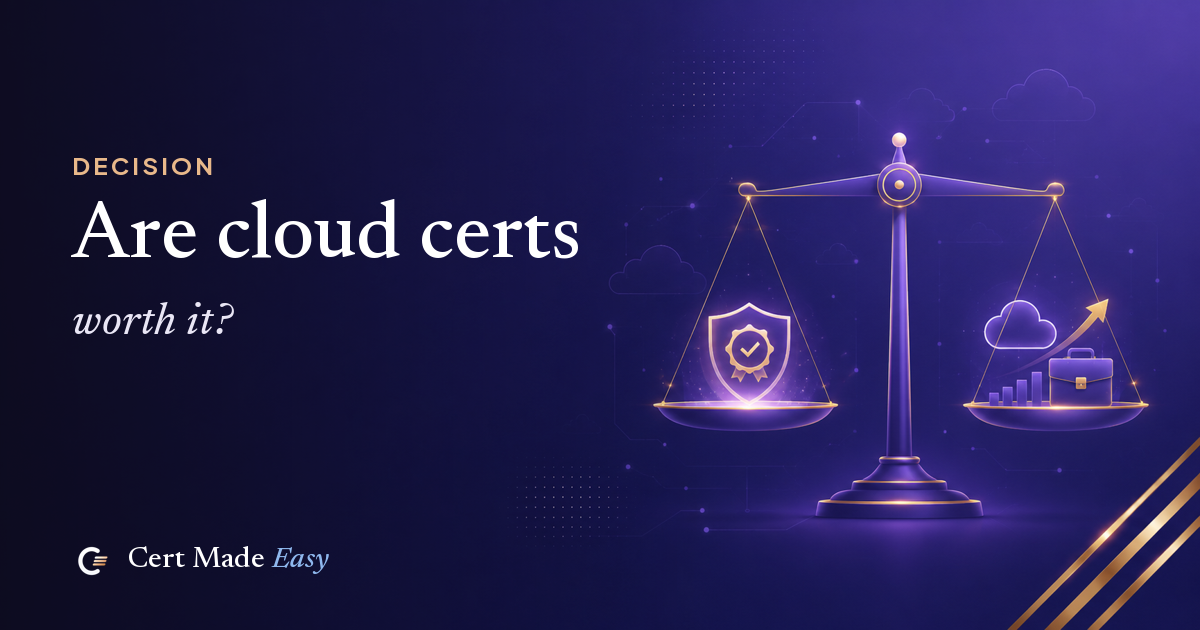
Short answer: yes, for most people, but not for everyone and not on their own. A cloud certification helps if you're breaking into cloud work, switching teams, or proving a skill in writing. It won't help much if you already have years of hands-on cloud experience and a portfolio to show for it.
Certs aren't magic. They pass you through resume filters, give a hiring manager a concrete reason to call you back, and force you to learn a platform in a structured way. That structure matters, and most people skip over it.
Short on time? Practice with realistic exam questions across AWS, Azure, and Google Cloud, each with a full explanation for every answer.
Who actually benefits from a cloud certification
Some people see real returns, some don't. A few patterns hold.
If you're a career changer or new grad, a cert signals that you studied this on purpose. It won't land you a senior role, but it gets your resume past ATS filters. If you're in IT or ops moving into cloud, a cert connects what you already know to what the job posting asks for. Many developers deploy to AWS or Azure without understanding what happens under the hood, and a cert fills that gap. And for consultants and freelancers, clients often require certified people on projects, so the cert has a direct business reason to exist.
Underneath all four cases is the same thing: a cert helps most when you have a gap between your current title and your target role.
When cloud certifications aren't worth it
Skip the cert if any of these apply:
You already have several years of hands-on cloud experience and projects you can discuss. Your work speaks louder than a badge.
You're chasing certs to avoid building things. Interviewers can tell the difference between someone who passed an exam and someone who broke production at 2am and fixed it.
You're considering an advanced cert before you have the foundations or a job that needs it. Specialty exams cost $150–$300. Don't buy one because it sounds impressive.
Exam logistics and salary impact
| Cert | Cost | Duration | Format | Passing Score | Validity |
|---|---|---|---|---|---|
| AWS CLF | $100 | 90 min | 65 questions | 700/1000 | 3 years |
| AZ-900 | $99 | 45 min | 40–60 questions | 700/1000 | 3 years |
| Google CDL | $99 | 90 min | 50–60 questions | Not published | 3 years |
| AWS SAA-C03 | $150 | 130 min | 65 questions | 720/1000 | 3 years |
| AZ-104 | $165 | 100 min | 40–60 questions | 700/1000 | 1 year |
| GCP ACE | $125 | 120 min | 50–60 questions | Not published | 3 years |
Cloud roles with a certification pay more, but the amount depends on your starting position and platform.
| Role | Typical Base Salary (US, 2026) | Cert Impact |
|---|---|---|
| Cloud Practitioner / Support Associate | $101,000–$135,000 | Entry-level filter |
| Cloud Engineer / DevOps | $129,000–$143,000 | 10–15% lift; required for many teams |
| Solutions Architect Associate | $114,000–$155,000 | Major jump from Cloud Practitioner |
| Cloud Architect / Principal | $154,000–$195,000 | Cert + deep hands-on required |
The best ROI is your first cert on the platform you actually plan to use. After that, each additional cert helps less unless you're switching platforms or targeting a specialization that explicitly requires it.
Which certification to start with
Choose one based on your experience level and target platform.
Entry-level (best if you're new to cloud)
- AWS Cloud Practitioner (CLF-C02), Best if you've never worked with cloud. $100, 90 min, 700/1000 passing score.
- Azure Fundamentals (AZ-900), Best if you're targeting companies already using Azure. $99, 45 min, 700/1000 passing score.
- Google Cloud Digital Leader (CDL), Best if you're headed toward data, analytics, or ML. $99, 90 min.
Associate-level (best if you have IT or dev experience)
- AWS Solutions Architect - Associate (SAA-C03), The most recognized cloud cert for engineering roles. $150, 130 min, 720/1000 passing score.
- Azure Administrator (AZ-104), Best if you're already hands-on with Azure. $165, 100 min.
- GCP Associate Cloud Engineer (ACE), The most technical GCP entry-level cert. $125, 120 min.
If you already have solid IT experience, go straight to associate-level. Foundational exams target people new to cloud. Pick one platform and go deep instead of spreading yourself across three clouds at beginner level.
How to make a cloud certification count
Most people cram, pass, and learn almost nothing useful for the job.
Study hands-on at the same time. Open a free-tier account, build something small, break it, fix it. Deploy a static site, set up a VPC, lock down an IAM policy. The exam tests whether you know the concepts. The job tests whether you can use them.
Use exam-style questions. Watching courses makes you feel ready without proving it. Practice with realistic questions and study the explanations so you learn why, not just which letter to pick.
Learn the vendor's question patterns. By your final week, you should know how AWS asks questions, which services appear in scenarios, what trade-offs they emphasize. That pattern recognition is learnable and moves your score in the final push.
Put it on your resume and prove it with work. Add the cert to your resume and LinkedIn, but also have something to talk about that you built while studying. "I'm AWS certified and here's a project I deployed to prove it" beats just the badge.
What comes after your first cert
If you want to go deeper on the same platform: Get the next associate or professional cert. AWS Solutions Architect Associate to Professional is the most common next step.
If you want to move to a different cloud: Start with the foundational or associate cert on that cloud. One solid cert on platform A plus one associate cert on platform B looks much better than three foundational certs spread across three platforms.
If you want to specialize: Get a specialty cert only after you have a strong foundational cert on your main platform and hands-on work to back it up. Specialty certs are expensive ($300) and narrow, only pursue them if a job explicitly requires it.
See Cloud Practitioner vs Solutions Architect to compare paths and check the job market for your situation.
Frequently asked questions
How long does it take to prepare for a cloud certification?
Entry-level certs (Cloud Practitioner, AZ-900, CDL): 1–3 weeks at 1–2 hours/day if you're starting fresh.
Associate certs (SAA-C03, AZ-104, ACE): 4–8 weeks at 1–2 hours/day for someone working full-time. If you already work with the platform, 3–4 weeks is reasonable.
The last two weeks should be almost entirely practice questions; that's where your score moves.
Does a cloud certification expire? How do I renew?
Yes, they expire. Most cloud certs are valid for three years. Renew by passing the same exam again or taking a newer version.
AWS, Azure, and Google Cloud all allow renewals through official exams. Plan to renew about 6–12 months before expiration.
Should I get a cloud certification or just learn by doing?
If you have a job that teaches you AWS, Azure, or GCP on the job, take it. Most people don't have that option.
A cert adds structure. It tells you what you should know, in what order, and gives you a deadline that forces you to finish instead of half-learning things for months. Best case: do both. Get the cert for the structure and resume signal, and build things while you study for the skills that actually matter on the job.
What's the pass rate for cloud certifications?
AWS, Microsoft, and Google don't publish official pass rates. The widely circulated estimates run like this:
- Cloud Practitioner: ~60–70% pass on first attempt
- Associate certs (SAA-C03, AZ-104, ACE): ~50–65% pass on first attempt
- Professional and specialty certs: ~40–55% pass on first attempt
If you fail, it's rarely about brains. People who fail usually ran out of the right kind of practice or study time.
Ready to start practicing?
Start with 10 free realistic exam-style questions.
Browse all problem sets →Keep reading
 AWS
2 min read
AWS
2 min read
SAA-C03 Dumps: Why a Bigger Bank Beats a PDF
Looking for SAA-C03 dumps? Here's why a stale PDF fails a scenario-based exam, the risk you take, and an 876-question exam-style bank that actually preps you.
Jul 15, 2026 Azure
2 min read
Azure
2 min read
AZ-104 Dumps: Why They Fail on a Hands-On Exam
Looking for AZ-104 dumps? Here's why they backfire on an exam that can drop you into live Azure labs, the real risk, and how to actually pass.
Jul 15, 2026